Let's be honest: managing an Airbnb listing is a bit like playing Tetris with prices. One day, you tell yourself that $80 a night is reasonable. The next day, you discover that your neighbor is renting a similar apartment for $65 and they're fully booked. Meanwhile, you're still waiting for your first booking of the month. If this situation sounds familiar, don't worry: you're not alone. Many hosts struggle daily with this impossible equation. But now a solution is gradually emerging, powered by artificial intelligence: dynamic pricing. And no, it's not reserved for experts or managers of twenty apartments. It's accessible to everyone, even if you're just renting out your studio while on vacation. This guide explains how it works, how to choose a tool, the mistakes to avoid, and how Nowistay's built-in AI Pricing sets one price for every channel, with PriceLabs as an alternative.

Sign up free. AI Pricing built in (or PriceLabs if you prefer), one price for every channel, direct booking engine: all in one platform.
Start free trialLet’s talk frankly. Setting the right price on Airbnb is a bit like walking a tightrope. Too high, and nobody clicks on your listing. Too low, and you feel like you’re selling your property short while wondering if you’re not coming across as a low-quality option.
Claire, a host for three years in Lyon (France) confided: “At first, I was changing my prices every two days. I’d watch what others were doing, compare, stress out. And in the end, I was wasting tons of time for mediocre results.”
This is exactly where dynamic pricing comes in. Instead of fixing a single rate that never really matches market reality, it allows you to automatically adjust your property’s price based on dozens of variables. Demand explodes before a festival? Your price goes up. A slow week in November? It drops to stay attractive.
The goal is simple on paper, but complex in practice: sell each night at the best possible price, without missing opportunities.
In a market where guests compare many listings before booking, being at the right price at the right time makes all the difference.
Concretely, dynamic pricing is like having a market analyst working for you 24/7. Except that instead of a human who sleeps at night and takes weekends off, it’s an algorithm that never stops.
The basic principle is relatively simple: your rate evolves automatically based on what’s happening in the market. But behind this apparent simplicity lies a sophisticated mechanism.
Imagine an electronic brain constantly observing dozens of signals:
What really changes the game today is these AI systems’ instant reaction capability (especially on Airbnb).
Let’s take a concrete example. A big Beyoncé concert is announced in your city three months from now. Instantly, the algorithm detects the event, estimates the influx of visitors, analyzes available accommodation capacity, and adjusts your rate in a few minutes. No need to wait until you stumble upon the news by chance.
Conversely, imagine a storm is forecast for next weekend and several travelers cancel. The AI notices immediately and slightly lowers your rates to attract the few people still looking for accommodation, rather than leaving your apartment empty.
Thomas, who manages three properties in Bordeaux (France), explained: “Before, I had empty nights that I could have easily rented for $50 instead of $80. Now, the algorithm does it on its own. I no longer miss those opportunities.”
No human can maintain this permanent reactivity. Even the most conscientious host won’t check their rates every hour.
Have a look at: AI Airbnb: How artificial intelligence is revolutionizing vacation rentals in 2026
Let’s talk results. Because beyond the technology, what matters is the impact on your bank account and on travelers’ experience.
Hosts who adopt dynamic pricing often see their annual revenue rise, mainly because they stop underpricing their busiest dates. Even a modest gain adds up to a meaningful amount over a year.
But beyond the numbers, there’s the gain in time and peace of mind. No more evenings comparing competitors’ prices, hesitating between $75 and $82, wondering if you should have lowered your price earlier.
Sophie, a host in Nice (France), sums it up well: “Now, I focus on what really matters: welcoming my guests, maintaining the property, the little touches. Prices are no longer my problem. And paradoxically, I earn more.”
Occupancy rates also improve. During slow periods, the algorithm offers attractive rates that continue to attract travelers rather than leaving your property empty out of pride.
You might think only hosts benefit. In reality, travelers also benefit from this more fluid market logic.
Rates become fairer because they reflect actual demand. A Tuesday night in November logically costs less than a Saturday night in July. It’s normal, and travelers accept it.
Available inventory stays broader too. When hosts optimize their revenue, they’re less tempted to remove their properties from the platform. Price flexibility maintains the attractiveness of the offering.
Finally, transparency improves. Price fluctuations are no longer perceived as arbitrary or unfair, but as a logical reflection of supply and demand at a given moment.
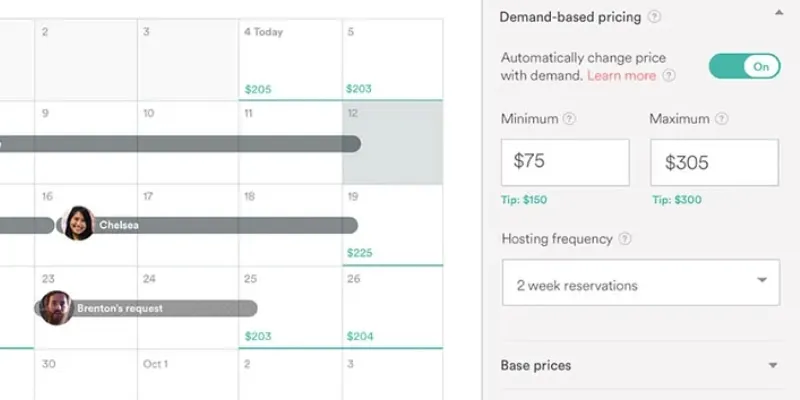
Concretely, how do you implement this dynamic pricing? Several solutions are available, from the simplest to the most sophisticated: Airbnb’s own tool, external pricing tools, and dynamic pricing built into your PMS, such as Nowistay’s AI Pricing.
Airbnb offers its own system called Smart Pricing. It’s free, already integrated into your interface, and does the job for beginners. The tool automatically adjusts your rates according to market trends.
The problem? It remains fairly basic and often too cautious. Many experienced hosts find it too conservative, missing opportunities to maximize revenue.
To go further, several third-party solutions leverage AI more extensively:
The right tool is the one that fits your portfolio and the way you work, not the one with the longest feature list. Check these points before you commit:
If you are listed on several platforms, connect the pricing tool to your PMS rather than to each platform separately. The tool calculates your prices and sends them to the PMS, and the channel manager pushes the same rates and restrictions to Airbnb, Booking.com, Vrbo and Expedia. You keep one source of truth for prices and avoid gaps between channels.
Three habits make this setup work:
If your calendar runs in Nowistay, you don’t need to connect a separate tool. AI Pricing is Nowistay’s built-in dynamic pricing, included in the AI Channel Manager plan at no extra cost. It suggests a nightly price for every free night over the next 2 years, gives the reason behind each change, and sends applied prices to every connected channel. In the app, you find it under AI Pricing in the left menu, just below Calendars.
Every suggestion starts from three settings you choose for each property:
From there, AI Pricing follows about 20 similar homes near yours and combines, night by night:
Applied prices are written to your Nowistay calendar and sent to Airbnb, Booking.com, Vrbo, Expedia and your direct booking website. Per-channel rate adjustments, such as +15% on Airbnb, stay on top, and the suggested price excludes the cleaning fee and taxes.
AI Pricing works for properties connected to Nowistay PMS, Nowistay’s channel manager, on the AI Channel Manager plan. It prices single units: multi-unit properties are not supported yet. A property whose prices are managed by PriceLabs keeps PriceLabs until you switch it.
PriceLabs remains available as an integration, with its own subscription billed by PriceLabs. Each property uses one or the other. You generate a key in Nowistay, import your listings into PriceLabs and turn on its daily price sync: PriceLabs can then update rates, minimum stays and check-in or check-out restrictions, and Nowistay sends them to your connected channels. If you later want to move a property to AI Pricing, you switch it in one click from the AI Pricing page.
Step-by-step guides:
A dynamic pricing tool is powerful, but it is only as good as its settings. These are the mistakes hosts make most often:
If your town is quiet in summer and full for autumn festivals, dynamic pricing still works: most pricing tools learn seasonality from demand in your own market, not from a fixed summer peak. PriceLabs, for example, says its algorithm already accounts for your market’s seasonality and advises replacing it with your own seasons only when you really need to (PriceLabs help). Where local data is thin, because few comparable listings exist or events change dates every year, set three things by hand: event dates with a higher price and a longer minimum stay, a minimum price that keeps your quiet season profitable, and a weekly look at the months ahead. In Nowistay’s AI Pricing, the season comes from how the prices of similar homes nearby change over the year, and you can add event dates as written instructions, for example “+20% during the festival, 7 to 26 July 2027” (minimum stays are set in the calendar).
Dynamic pricing isn’t a recent invention. Airlines have been using it since the 1980s, hotel chains since the 2000s. But the arrival of AI has changed everything: what once required teams of analysts and six-figure software becomes accessible to any individual with a smartphone.
Tomorrow, these algorithms will go even further. They’ll integrate travelers’ individual preferences, their booking histories, real-time weather data, even social and cultural events detected on social networks. Personalized pricing will become the norm.
Some tools are already starting to offer different rates depending on the traveler’s profile: a honeymooning couple might accept to pay more than a backpacking student. Of course, this raises ethical questions that will need to be carefully addressed.
So, should you adopt dynamic pricing? If you’re still asking yourself the question after reading this article, the answer is probably yes.
Hosts who integrate these dynamic pricing tools now take a significant head start over their competitors. In a market as dynamic and competitive as Airbnb, whoever masters their prices masters their profitability.
Start simply with Smart Pricing to understand the mechanisms. Then, if you want to go further, test an external solution for a few months or, if your calendar runs in Nowistay, start AI Pricing in Suggestions mode: you see every proposed price and its reason before anything changes. The results will speak for themselves.
Artificial intelligence is no longer the future of short-term rentals: it’s the present. And those who ignore it simply risk being left behind.
In summary, dynamic pricing on Airbnb isn’t a technological gadget reserved for professionals. It’s an intelligent, accessible, and profitable management method that benefits both hosts and travelers. By entrusting AI with the mission of continuously analyzing, predicting, and adjusting your rates, you focus on what’s essential: offering an unforgettable experience to your guests. Because in the end, that’s what really matters.
First month free. AI Pricing suggests a price for every free night, with the reason, and can apply it every morning.
Try Nowistay free

Over 25 years of experience in real estate investing and a recognized expert in short-term rental automation. Bassel helps property managers increase revenue, cut operating costs, and deliver 5-star guest experiences using AI-powered tools he built from firsthand hosting experience.
